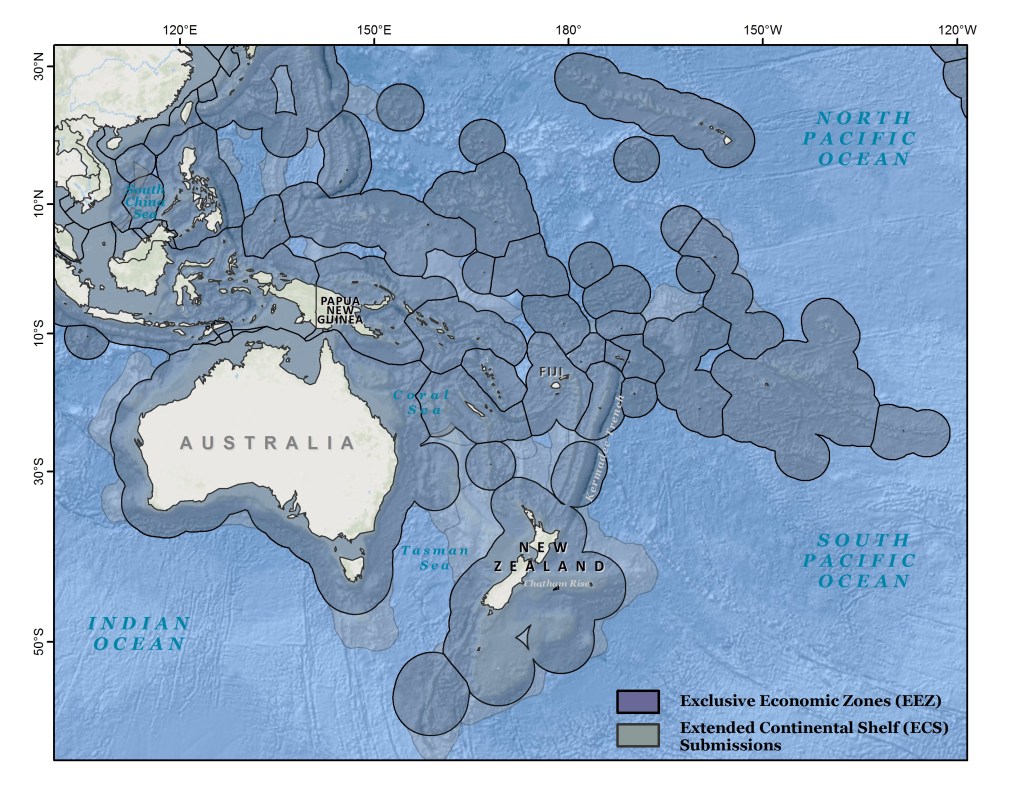
2017 Sammler. “The deep Pacific: Island governance and seabed mineral development” pp. 10-31, in Stratford (ed.), Island geographies: Essays and conversations, New York, NY: Routledge. https://doi.org/10.4324/9781315686202.
The deep sea has been understood as a place of profound mysteries, obscured from extensive scientific inquiry by a few thousand metres of dark, cold, salty seawater. Very little of the ocean’s depths have been explored in detail because of its immensity and the expense of operating in its extreme conditions. Yet in the last few years global metal markets and technological advancements have made deep seabed resource extraction increasingly feasible. Seabed mining remains an experimental technology intended to dredge up mineral sands, nodules, cones and crusts that contain ores accumulated on and within the seafloor. In the struggle to meet resource production demands, some have turned offshore to satisfy growing food, fuel, and mineral appetites, implicating the seabed as the latest location for large-scale resource extraction. However, arguments put forth regarding seabed mining as inevitable, as essential progress towards harnessing this “frontier” space, disregard previous attempts and failures of such endeavours.
Chapter preprint open access: https://saltygeographies.files.wordpress.com/2015/08/sammler_chapter2_final.pdf
Full book for purchase: https://www.routledge.com/Island-Geographies-Essays-and-conversations/Stratford/p/book/9781138921726.
 Marine Political Ecology Collective