Lacerda LD de, Ferreira AC, Borges R, Ward R. Challenges to mangroves of the Semiarid Equatorial Coast of Brazil in the Anthropocene. Cambridge Prisms: Coastal Futures. 2024;2:e17. https://doi.org/10.1017/cft.2024.16
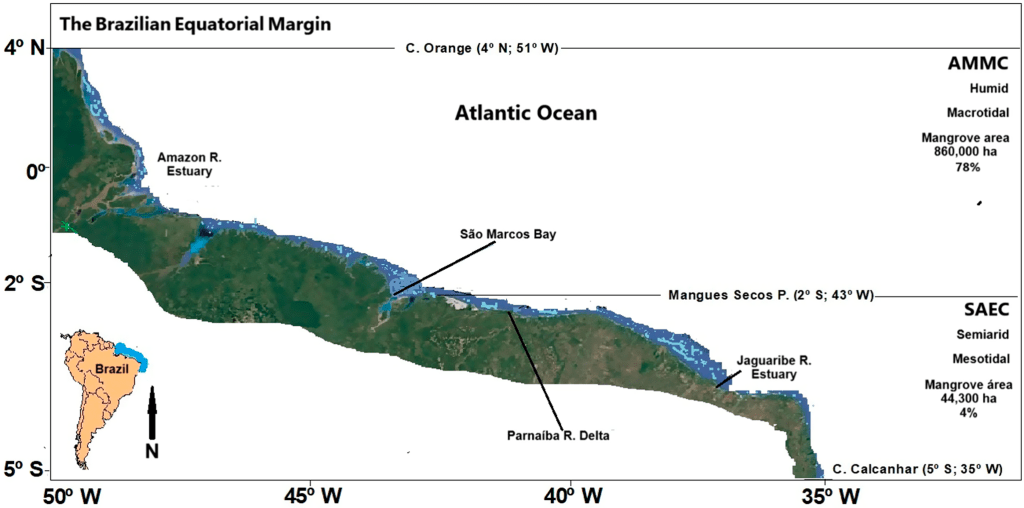
The semiarid northeast coast of Brazil harbours just less than 44,300 ha of mangroves, 4% of Brazilian total. Notwithstanding this relatively small area, these forests have high ecological and economic importance, sustaining traditional fisheries and protecting biodiversity, including many threatened species. They present unique biogeochemical characteristics resulting in distinct ecosystem functioning compared to mangroves located in humid areas. Semiarid mangroves present lower aboveground biomass compared to humid region mangroves but show similar belowground biomass. Whereas mangrove soils in humid areas are strongly influenced by sulphate reduction, iron geochemistry is a primary driver of soil characteristics in semiarid mangrove soils, suggesting different responses to climate change drivers between them. Although legally protected, they have incurred continuous degradation due to regional drivers, mostly aquaculture and river damming, which differs from those in humid coast mangroves. Semiarid mangroves are also particularly sensitive to drivers associated with global climate change (high temperatures, reduced rainfall and sea level rise). These conditions occur at a global scale; however, the impacts are worsened by the natural conditions of semiarid coastlines, which already provide biologically stressful conditions for mangroves. This article compares the impacts of such drivers in semiarid mangroves with those of humid mangroves, focusing on their biogeochemical response and eventual rehabilitation.
 Marine Political Ecology Collective